
49
Leandro Bassano (Bassano del Grappa, 1557 - Venezia, 1622)
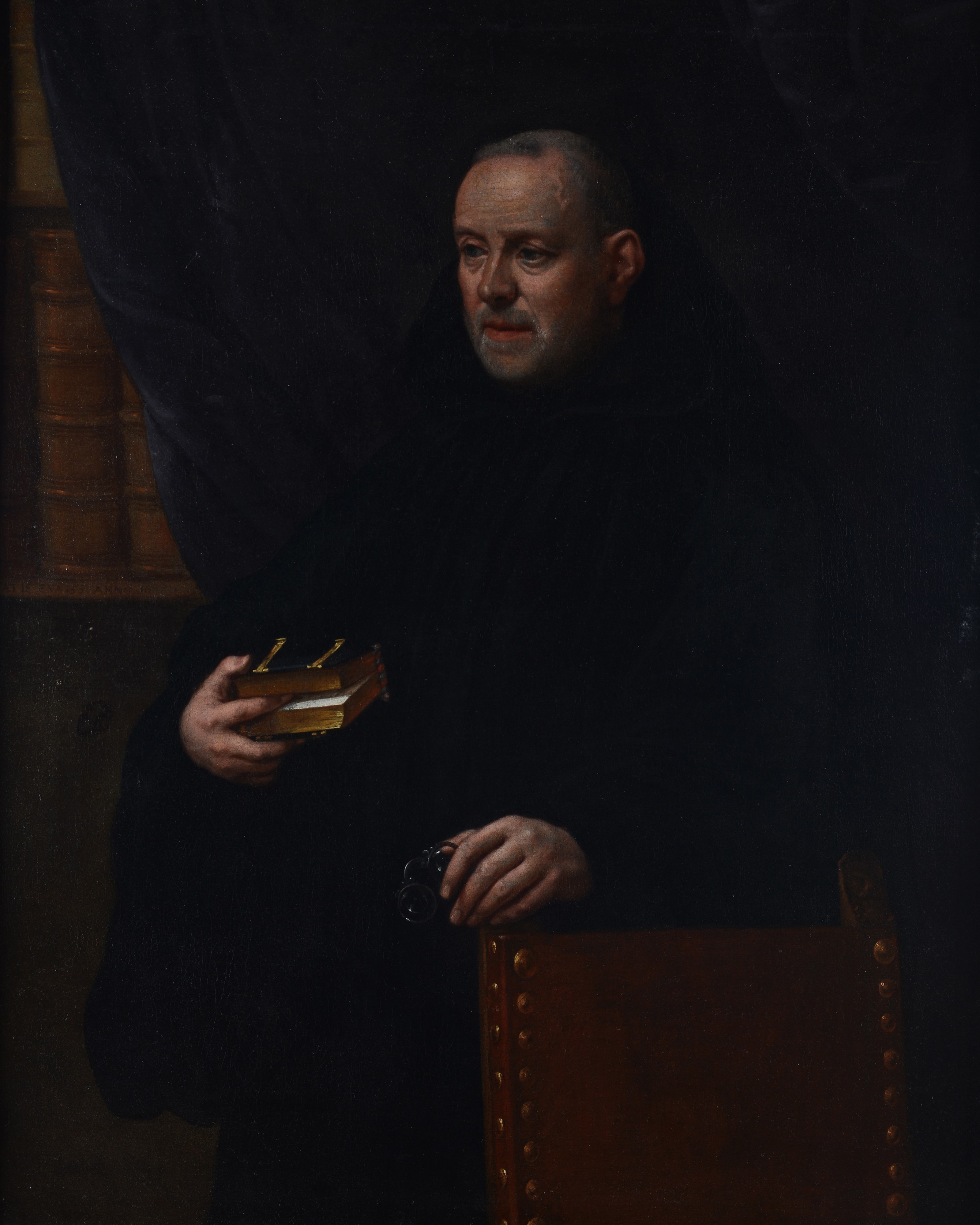
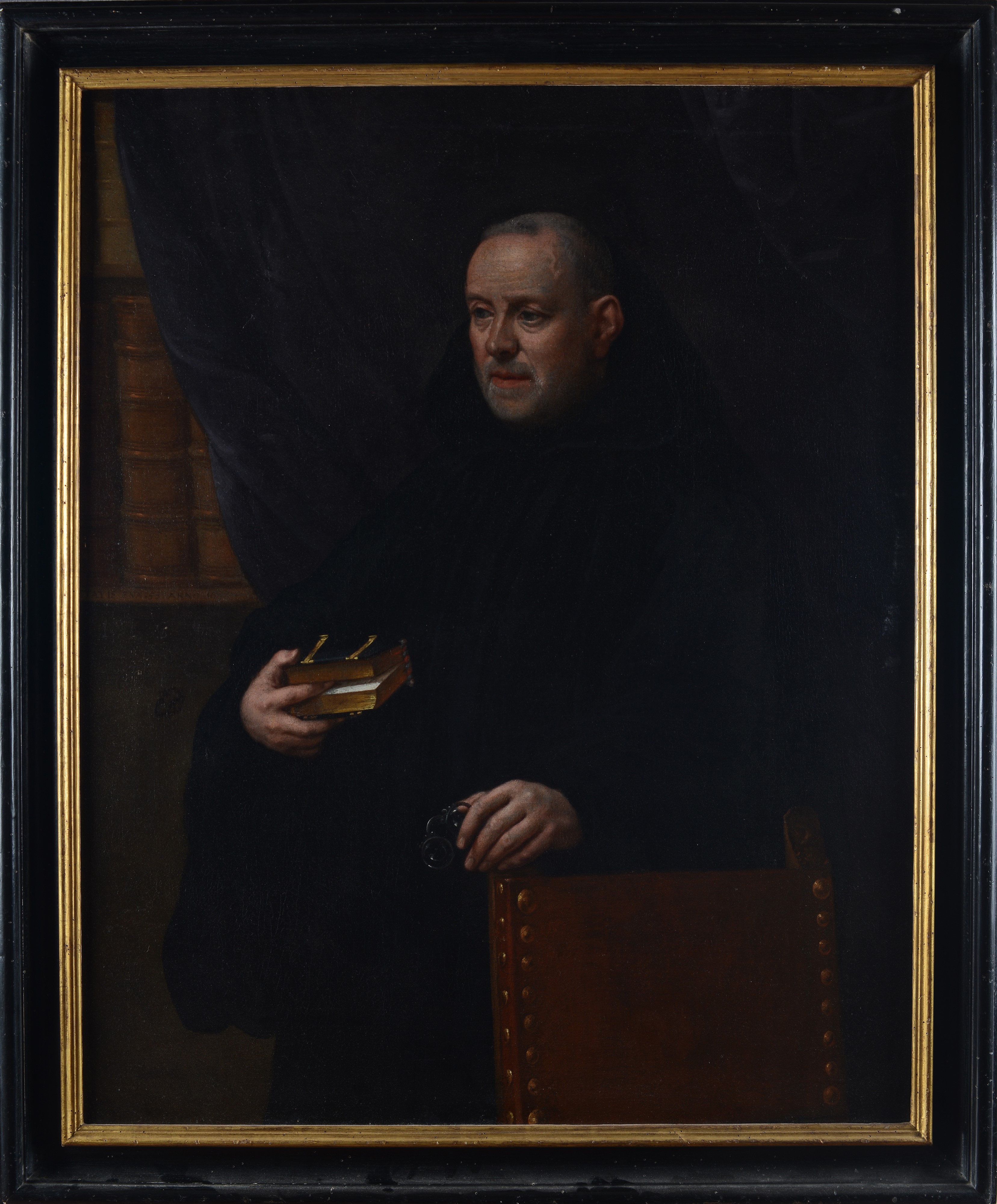
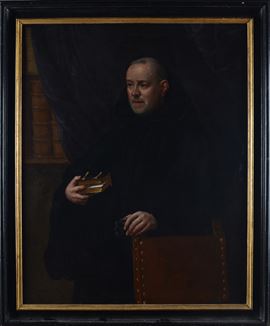
Portrait of a friar with a book
Oil on canvas
cm. 115.5x93.5
Expertise by Prof. Ugo Ruggeri. Expertise by Prof. Giuseppe Maria Pilo. Art Loss Register certificate.
The work was subject to a Notification of Cultural Interest from the Ministry of Cultural Heritage and Activities, dated 14 January 2013, with a related historical-artistic report.
"The painting, oil on canvas, depicts a mature man, who, due to his tonsure and black cassock, can be identified as a clergyman, portrayed inside his study, where enormous leather-bound volumes appear in the background.
The work was subject to a Notification of Cultural Interest from the Ministry of Cultural Heritage and Activities, dated 14 January 2013, with a related historical-artistic report.
"The painting, oil on canvas, depicts a mature man, who, due to his tonsure and black cassock, can be identified as a clergyman, portrayed inside his study, where enormous leather-bound volumes appear in the background.
That he is clearly a scholar is confirmed by the book and the "glasses" held by "outstretched, delicate and very long" hands (E. Arslan, I Bassano, Milan, 1960, p.247) but also by the subtle psychological insight of the character, whose inner sensitivity and gentle introversion are captured.
The extreme refinement of the painting, characterised by a refined combination of blacks and browns, certainly places the work, of which there is no known previous bibliography, among the most successful results of the portraiture of Leandro dal Ponte (1557-1622), the third-born son of Jacopo known as Bassano. Leandro's particular ability in portraiture is confirmed by sources, starting from Ridolfi (Le meraviglie dell'arte ovvero le vite degli illustri pittori veneti e dello stato, Venice, 1648, ed. von Hadeln, Berlin, 1914-1924, II, p.167), who reports that "the beauty of his portraits was universally preached" and from Verci (Pittori, scultori e intagliatori della città di Bassano, Venice, 1775, ed. Sala Bolognese 1975, p.187) who highlighted: "The greatest merit, however, that experts in art unanimously recognized in this painter, is that of having been a very graceful portraitist, taking images so from nature that they seemed to breathe soul and life; so that in this kind of painting, making his own ability stand out excellently, he rose to a high level of esteem even in the countries beyond the mountains, and Princes and Potentates, and Cardinals, and great Lords vied to be portrayed by Leandro's brush".
Leandro's portraiture, of which sources list numerous and illustrious examples, most of which have remained untraced beyond the "corpus" identified by Arslan (1960), has been enriched by further critical attributions but has not yet been the subject of systematic study. His artistic path is, however, commonly identified by critics as a transition from a youthful phase influenced by Tintoretto to an official portraiture, albeit approached with a realistic approach, and to the more intense and lyrical humanity of his mature production, which is influenced by Emilian (the Carracci and especially Bartolomeo Passerotti), Flemish (Francesco Pourbus), and Lombard (Giovan Battista Moroni) examples.
The portrait presented for export must be ascribed to this mature production, which reflects both the "melancholic humor" attributed to him by Ridolfi and the ability he showed "as a portraitist, indicating with acute characterization the different psychological values". (Arslan, 1960 p. 241)
Due to its high pictorial quality, the painting in question is comparable to works from the first quarter of the 17th century, such as the Portrait of a Man from the Dresden Art Gallery, the Lute Player with Dog from the Lubomirski collection in Krakow, the Portrait of Alvise Corradini from the Civic Museum of Padua, and the Sebastiano Fuginelli, formerly in the Drey and Morlacchi collection.
The portrait presented for export must certainly be considered a masterpiece of Leandro's late activity, fundamental for the qualitative evaluation of this phase of the painter's career. [..]"
Ministerial historical-artistic report, attached to the Notification of Cultural Interest dated 14 January 2013 (Superintendency of Verona, signed by Dr. S. Urciuoli).
Ministerial historical-artistic report, attached to the Notification of Cultural Interest dated 14 January 2013 (Superintendency of Verona, signed by Dr. S. Urciuoli).
€ 10.000,00 / 15.000,00
Estimate
Unsold